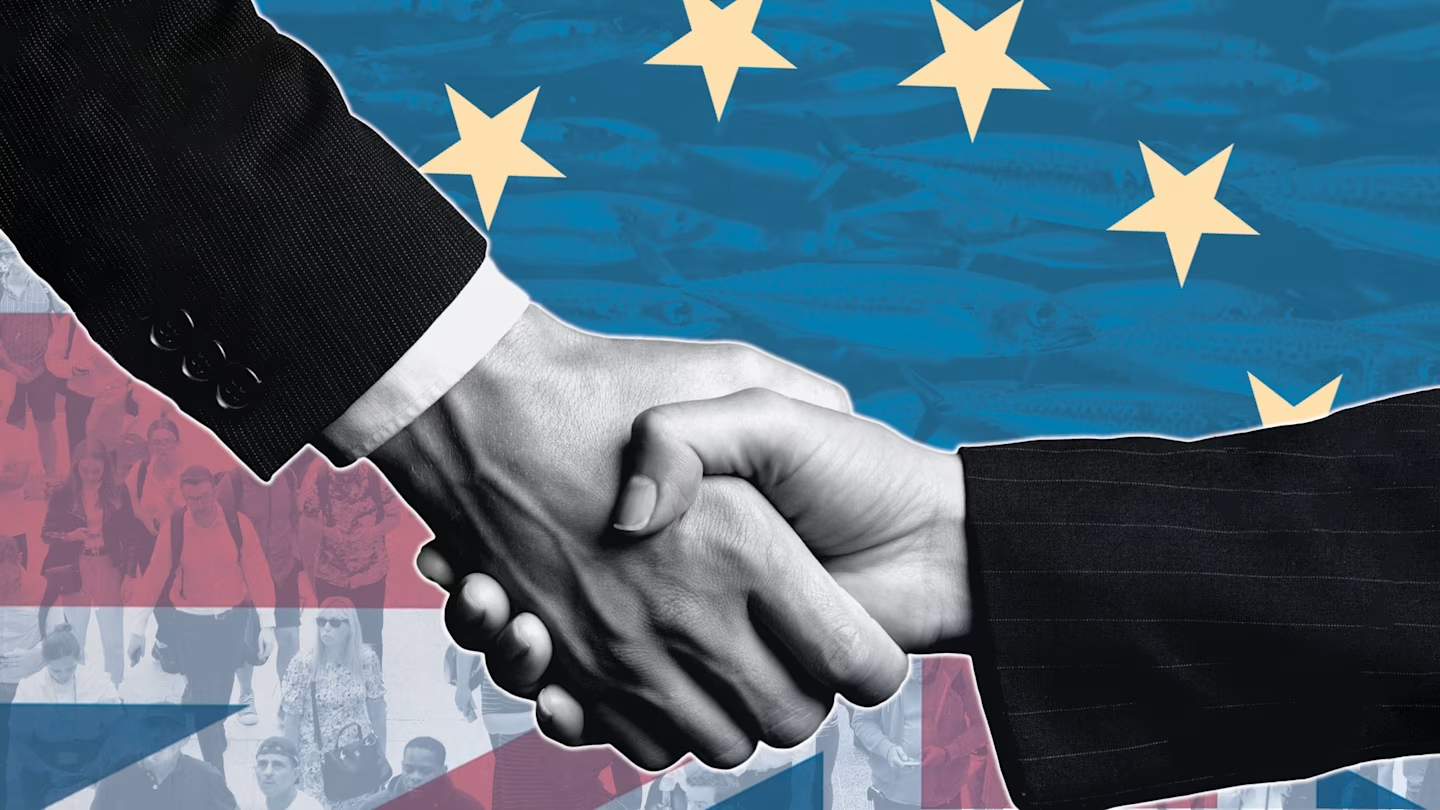
Cooperation in security and justice has undergone significant changes. The UK abandoned the European Arrest Warrant system and the SIS II database, replacing them with bilateral agreements and participation in Interpol. Although operational cooperation between intelligence agencies remains high (particularly in the fight against terrorism), bureaucratic barriers have slowed data exchange. In 2024, London and Brussels began negotiations on a new agreement to combat organized crime, recognizing their mutual interest in security.
Scientific and academic cooperation suffered from the withdrawal from programs like Horizon Europe. After a two-year absence, the UK returned to the program in 2023 as an associate member, but the terms of participation are less favorable than those of EU membership. Many researchers left British universities, fearing isolation from European projects. However, the government responded by creating a national fund, Industrial Strategy 2030, with a budget of £22 billion for research in artificial intelligence, quantum technologies, and green energy.
Political dialogue between London and Brussels has normalized after a period of tension under Boris Johnson. Regular ministerial meetings and the creation of the Joint Partnership Council provided a platform for resolving contentious issues. In 2025, the parties began negotiations to expand the agreement to cover digital trade and the recognition of professional qualifications—steps aimed at reducing barriers for business. However, a fundamental difference in approach remains: the EU insists on a “level of protection” equivalent to European standards, while the UK seeks regulatory autonomy.
Relations with individual EU countries are developing asymmetrically. Strong economic ties remain with Germany and France, but political disagreements arise over fisheries and cross-Channel migration. Relations with Ireland remain strategically important due to the shared island and the historical context of the Northern Ireland Peace Agreement. Spain continues to raise the Gibraltar issue, although the parties reached a preliminary agreement in 2023 to create a “hybrid zone” to facilitate the movement of people and goods.
Advertising